

More energy, faster recovery, slower aging: these promises often appear in advertisements for NAD⁺, NADH and NMN. These substances really do play important roles in cells. But does that mean a dietary supplement or an intravenous infusion can help people stay young for longer?
NAD and its essential role in cells
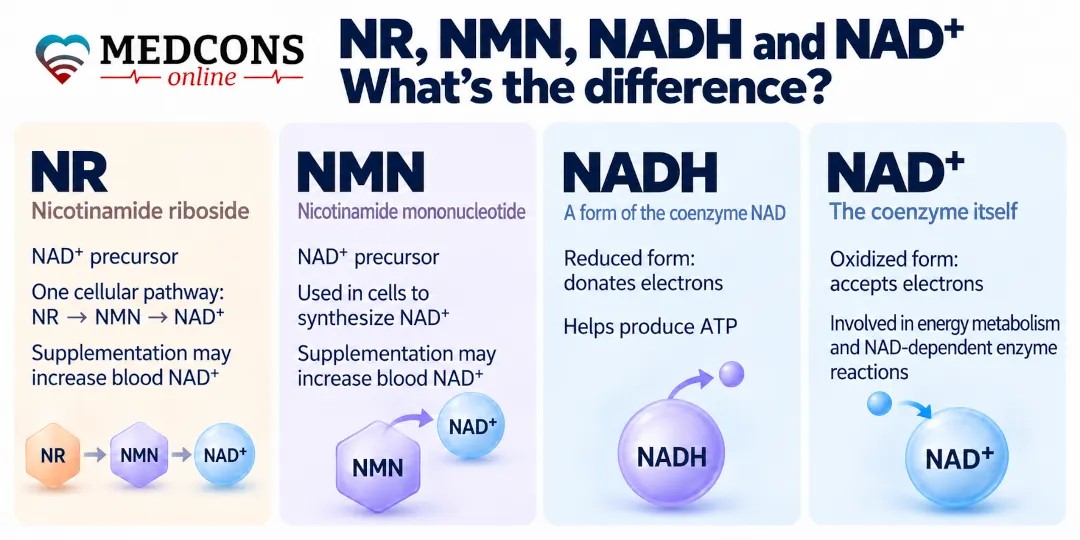
The advertised drugs have similar names, but the substances they contain have different functions. NAD, or nicotinamide adenine dinucleotide, is produced by the body itself. It is a coenzyme: it helps enzymes carry out reactions that cells need to function.
NAD exists in two closely related forms. NAD⁺ accepts electrons, while NADH passes them on. Both forms are biologically active and take part in metabolism.
The body makes NAD from vitamin B₃ forms, including nicotinic acid and nicotinamide, as well as from the amino acid tryptophan. These substances are found in everyday foods. NMN, or nicotinamide mononucleotide, and NR, or nicotinamide riboside, are precursors of NAD. Thus, each of these products should be assessed separately.
Cells need NAD for energy and repair
Cells need a constant supply of energy. NAD⁺ and NADH help extract it from nutrients. In mitochondria, electrons from NADH are used in the production of ATP, the main energy carrier in cells.
NAD⁺ is also needed by enzymes involved in repairing DNA damage and helping cells respond to stress.
These are the functions that advertisements often highlight. They describe real biological processes, but the question that matters to consumers is whether taking extra NAD improves how the body functions.
Anti-aging claims on the label and findings from research
Interest grew out of research linking age-related changes to NAD metabolism. Lower levels of NAD⁺ have been found in some tissues in older people. In animal experiments, raising NAD⁺ levels sometimes improved metabolism and certain bodily functions.
This led to an appealing idea to help cells perform as they did when they were young by restoring NAD levels.
Measuring this marker therefore cannot be treated as a straightforward test of youthfulness or a way to determine whether a supplement is needed.
Even a confirmed decline in a particular tissue does not mean that taking more of the substance will stop aging. The body is far more complex than a system in which replenishing a single supply is enough.
Rejuvenation with NAD⁺ and NADH supplements remains unproven
There is still no convincing evidence that oral NAD⁺ or NADH supplements extend human lifespan or produce lasting rejuvenation.
After they are swallowed, these substances may be broken down. Some breakdown products can be absorbed, so it is too sweeping to claim that the entire contents of a supplement are simply excreted and completely unavailable to the body. Even if absorption occurs, that does not establish the promised benefit.
Researchers need to trace the path from absorption to effects inside cells and benefits for health. Reliable evidence to support promises of rejuvenation is still lacking.
NMN and NR beyond the impressive numbers
NAD precursors attract attention because the body can use them to make this coenzyme. NMN and NR can indeed raise NAD⁺ levels in the blood. The implications for health are less clear.
Some small studies have found improvements in specific functions in particular groups of patients. For example, NMN improved muscle insulin sensitivity in women with prediabetes. This is an interesting finding, but it does not prove rejuvenation or benefits for all consumers.
The rise in the marker was not accompanied by a demonstrated improvement in these functions.
Straight into the bloodstream does not mean straight into cells
IV infusions bypass the digestive tract. This can create the impression of a more direct and powerful effect.
NAD⁺ can be broken down outside cells, and its use depends on cellular transport and metabolic processes. Delivering the substance into the bloodstream therefore does not automatically replenish NAD⁺ inside the cells that need it.
Some studies have examined its use as a treatment. For example, in patients with heart failure, intravenous NAD⁺ improved one measure of heart function alongside standard treatment.
Promises of “rapid rejuvenation” after a course of infusions therefore remain unsupported. There is also no convincing basis for claiming that IV infusions are more effective at extending lifespan than products taken orally.
Safety without lifelong guarantees
In human studies, NAD precursors were generally well tolerated over the examination periods. Trials lasting a few weeks or months, however, do not establish the safety of taking the substance for years.
In 2026, EFSA concluded that the specific β-NMN ingredient it assessed was safe for adults at doses of up to 300 mg per day, excluding pregnant and breastfeeding women. The specified composition and dose matter.
When buying a product, compare its composition and dose with those studied. The word “safe” on the packaging is not enough.
Infusions carry risks of their own
Intravenous administration requires control of product quality and sterility, as well as monitoring of how well the procedure is tolerated. It adds risks that do not arise from simply swallowing a capsule.
The warning concerns the quality of injectable products.
Without a proven rejuvenating effect, the risks of the procedure itself also need to be considered when evaluating what is being offered.
The link with cancer defies simple answers
Forums, chats and advertisements feature opposing claims: some describe higher NAD levels as protection against cancer, while others fear that they could accelerate tumor growth.
The scientific evidence is more complex. Both normal cells and tumor cells need NAD. In animal experiments, NR promoted tumor development and metastasis in one breast cancer model, but suppressed liver cancer progression in another.
The long-term cancer risk associated with NMN and NR remains insufficiently studied. Small, short studies cannot rule out rare consequences of years of use. People with cancer or receiving cancer treatment should discuss these supplements with their treating physician.
Putting advertising claims to the test
“Raises NAD⁺” and “supports energy”
These phrases may sound as though they promise the same benefit, but they mean different things.
Some NMN and NR supplements have been shown to raise NAD⁺ levels in humans. This is a biochemical change; it does not yet demonstrate improved well-being or a longer lifespan.
The phrase “supports cellular energy and repair” may draw on the known functions of NAD in the body.
If an advertisement promises that you will feel more energetic, check whether the study measured that outcome and found an advantage over placebo.
“Clinically studied”
This means the product has been studied in people. The study may have examined tolerability or blood NAD levels rather than the benefit promised in the advertisement.
Customer testimonials and “before and after” photographs are no substitute for controlled studies: many factors can influence how people feel and look.
“Rejuvenates” and “extends life”
These are the strongest claims, and convincing evidence in humans is still lacking.
Advertising rules vary between countries. Permitted wording or the legal sale of a product does not guarantee its effectiveness. A useful guide for consumers is whether the promised benefit matches the outcome actually demonstrated in the study.
For a healthy consumer, the central question remains the same: what proven benefit does the product offer?
References
1. Liu L et al. Quantitative Analysis of NAD Synthesis-Breakdown Fluxes. Cell Metabolism. 2018;27(5):1067–1080.e5. DOI: 10.1016/j.cmet.2018.03.018
2. Fiedorczuk K et al. Atomic structure of the entire mammalian mitochondrial complex I. Nature. 2016;538(7625):406–410. DOI: 10.1038/nature19794
3. Trętowicz MM et al. Human whole-blood NAD⁺ levels do not vary with age or lifestyle interventions. Nature Metabolism. 2026;8:1282–1290. DOI: 10.1038/s42255-026-01537-5
4. Gross CJ, Henderson LM. Digestion and Absorption of NAD by the Small Intestine of the Rat. The Journal of Nutrition. 1983;113(2):412–420. DOI: 10.1093/jn/113.2.412
5. Gallagher C, Emmanuel OO. NAD⁺ supplementation for anti-aging and wellness: A PRISMA-guided systematic review of preclinical and clinical evidence. Ageing Research Reviews. 2026;116:103057. DOI: 10.1016/j.arr.2026.103057
6. Christen S et al. The differential impact of three different NAD⁺ boosters on circulatory NAD and microbial metabolism in humans. Nature Metabolism. 2026;8:62–73. DOI: 10.1038/s42255-025-01421-8
7. Yoshino M et al. Nicotinamide mononucleotide increases muscle insulin sensitivity in prediabetic women. Science. 2021;372(6547):1224–1229. DOI: 10.1126/science.abe9985
8. Yu X et al. Effect of Nicotinamide Adenine Dinucleotide on Heart Failure Caused by Ischemic Cardiomyopathy: A Randomized, Placebo-Controlled Trial. American Journal of Cardiovascular Drugs. 2026;26(1):97–106. DOI: 10.1007/s40256-025-00764-7
9. EFSA Panel on Nutrition, Novel Foods and Food Allergens (NDA). Safety of beta-nicotinamide mononucleotide (β-NMN) pursuant the regulation (EU) 2015/2283 and the bioavailability of nicotinamide from this source in the context of Directive 2002/46/EC. EFSA Journal. 2026;24(5):e10007. DOI: 10.2903/j.efsa.2026.10007
Comments — 0